How to Sell a Gun in Alabama: A Comprehensive Guide
When buying or selling a firearm in the state of Alabama all parties involved should have knowledge of the state’s laws and regulations that govern…
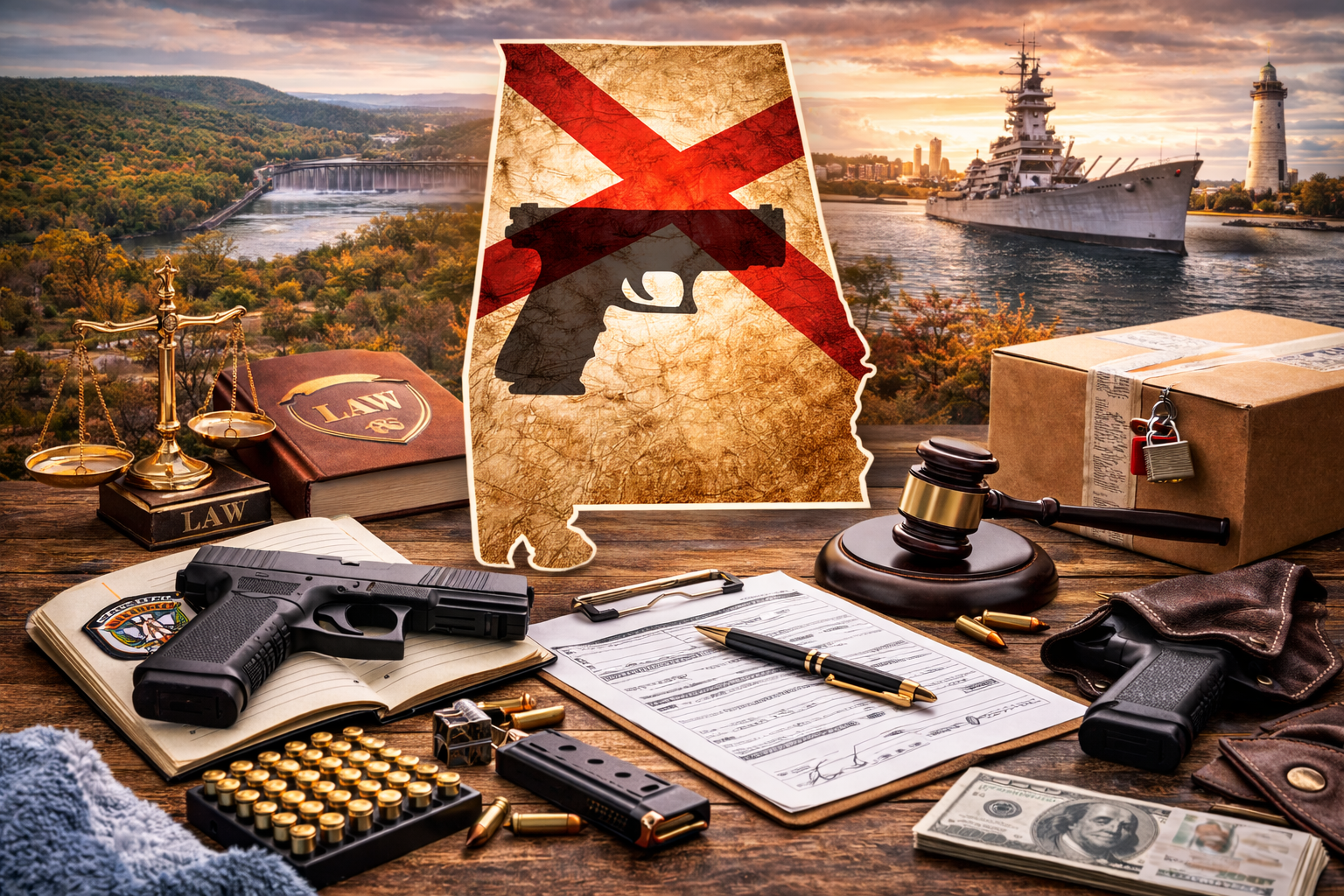
Alabama is one of the most firearms-friendly states in the country, and gun culture runs deep here. From the Birmingham Gun Show at Hoover Met to deer camps in the Black Belt, from Huntsville’s defense industry corridor to shrimp-and-shoot weekends on the Gulf Coast, firearms are woven into daily life across all 67 counties. The legal framework reflects that: permitless carry, no background check for private sales, no registration, no waiting period, and strong state preemption that prevents cities like Birmingham, Montgomery, and Mobile from imposing their own restrictions. This category covers every area of Alabama firearms law that affects gun owners, buyers, and sellers.
Alabama's reputation as a gun-friendly state is well earned, but "permissive" does not mean "unregulated." The state's firearms laws have real teeth in specific areas, and recent legislation has added new provisions that affect everyday gun owners. SB116 created a state-level felony for possessing Glock switches and auto sears. SB119 dramatically expanded the list of people prohibited from possessing firearms, extending the ban from violent felons to anyone convicted of any felony. SB281 established financial privacy protections preventing banks from flagging gun purchases.
Understanding where Alabama law is permissive and where it carries serious penalties is the difference between a routine transaction and a felony charge. Our guides break down every topic area, sourced directly from the Alabama Code, the Alabama Attorney General's memorandum to the ATF, and the Alabama Law Enforcement Agency.
While state preemption prevents cities from passing their own gun ordinances, local context still shapes how firearms law works in practice. The Birmingham metro (Jefferson and Shelby counties) hosts the state's largest gun shows at the Hoover Met Complex. Huntsville and the Tennessee Valley have a dense population of defense workers and military-connected gun owners near Redstone Arsenal. Mobile and the Gulf Coast serve as a hub for the southern Alabama gun show circuit, with shows rotating through the Abba Shrine Center and Orange Beach Event Center.
County sheriffs issue optional concealed carry permits (for reciprocity in 30+ states), and processing times and attitudes vary by county. Rural counties in the Black Belt and Wiregrass region typically process faster than urban Jefferson County.
Whether you're in downtown Birmingham, outside the gates of Fort Novosel in the Wiregrass, or on the causeway to Dauphin Island, the law is the same statewide. That's what preemption means. Our guides cover every provision that applies to you.
Key facts for anyone selling, buying, or carrying a firearm in Alabama. Covers private sales, carry laws, local selling options, and the latest legislative changes.
Alabama does not require background checks for private firearm sales. Two individuals can complete a transaction without involving the state. Only FFL dealer sales require a NICS check and ATF Form 4473. Sellers remain liable if the buyer is a prohibited person under Ala. Code § 13A-11-72(b).
Alabama imposes no waiting period on any firearm purchase. Whether you're buying at a Birmingham gun shop, a Huntsville pawn store, or through a private sale in rural Marengo County, the transfer completes as soon as a dealer check clears or the private parties agree.
No firearms registration exists in Alabama. The state does not maintain a database of privately owned firearms. There is no obligation to notify any agency after purchasing, inheriting, or receiving a firearm as a gift.
No permit, license, or state ID is required to buy or own any firearm in Alabama. No Firearm Owner ID card, no purchase permit, no handgun qualification license. Alabama defaults to federal eligibility requirements only.
Alabama enacted permitless (constitutional) carry effective January 1, 2023 under HB272. Anyone 21+ who can legally possess a firearm may carry concealed. Open carry is legal at 19+. Optional county sheriff permits (1-year or 5-year terms) are available for interstate reciprocity in 30+ states.
18 to purchase long guns (rifles, shotguns) and ammunition. 21 to purchase handguns from an FFL dealer. Alabama Code § 13A-11-75 prohibits selling, giving, or lending a handgun to anyone under 18. Federal minimums apply at all licensed dealers.
Alabama has no assault weapons ban, no magazine capacity restrictions, and no restrictions on specific firearm features like pistol grips or threaded barrels. SB116 (Oct 2025) targets only machine gun conversion devices, not semi-automatic firearms themselves.
Not legally required, and Alabama does not require ID exchange for private sales. Strongly recommended to protect both parties. Include make, model, serial number, caliber, both parties' full names and addresses, date, price, and a buyer eligibility statement.
Alabama Code § 11-80-11 prevents all 67 counties and municipalities from enacting firearms ordinances stricter than state law. Birmingham, Huntsville, Montgomery, Mobile, and Tuscaloosa all follow the same rules. Montgomery tested this with a 2024 local ID ordinance, but enforceability under preemption remains contested.
Alabama has one of the most active gun show circuits in the South. Regular shows rotate through the Hoover Met (Birmingham), Cahaba Shrine Temple (Huntsville), Abba Shrine Center (Mobile), Alcazar Shrine Center (Montgomery), and venues in Gadsden, Trussville, Muscle Shoals, Scottsboro, and Orange Beach. Private sale rules apply between non-dealers at shows.
Effective October 1, 2025. Class C felony (up to 10 years) to possess, sell, or use parts designed to convert a pistol into a machine gun. Prompted by the September 2024 Five Points South mass shooting. Exemptions for law enforcement, federally registered NFA items, and devices enabling no more than two shots per trigger pull.
Effective October 1, 2025. All felony convictions (not just violent) now bar firearm possession. Five-year post-conviction ban. Three or more felonies create a permanent ban. Individuals charged with violent crimes and released pending trial face a Class C felony for possessing a firearm. Sellers must exercise greater due diligence.
When buying or selling a firearm in the state of Alabama all parties involved should have knowledge of the state’s laws and regulations that govern…
Selling a firearm in Alabama involves specific legal requirements and procedures. Whether you’re downsizing your collection or selling a single…
Yes. Since January 2023, Alabama has been a permitless (constitutional) carry state. Anyone 21 or older who can legally possess a firearm may carry concealed without a permit. Open carry is legal at 19+. Optional permits are still available from county sheriffs for interstate reciprocity, recognized in over 30 states. Permits come in 1-year and 5-year terms.
No. Private sales between two individuals do not require a background check under Alabama law. Only purchases through a Federal Firearms Licensee (FFL) require a NICS check and Form 4473. Sellers in private transactions are still responsible for ensuring the buyer is not a prohibited person under Alabama Code § 13A-11-72(b) and federal law.
Alabama restricts firearms in police and sheriff stations, courthouses, prisons and jails, K-12 school buildings (parking lot exceptions for locked vehicles), athletic event facilities, mental health facilities, and buildings with continuous security. Federal restrictions add post offices, federal buildings, airports (beyond security), and military installations like Redstone Arsenal and Fort Novosel. Violating school premises carry with intent to harm is a Class C felony under SB119.
SB116, effective October 2025, makes it a Class C felony (up to 10 years) to possess, sell, or use parts designed to convert a pistol into a machine gun. These include Glock switches and auto sears. Exemptions cover law enforcement, federally registered NFA items, and devices enabling no more than two shots per trigger pull.
Under § 13A-11-72(b) as amended by SB119 (October 2025): anyone convicted of any felony, anyone with a felony in the last five years, anyone with three or more felony convictions (permanent), anyone convicted of violent crimes or domestic violence, anyone subject to a domestic abuse protection order, anyone of unsound mind, and anyone charged with a violent crime while released pending trial. Federal categories also apply.
Yes. Alabama Code § 11-80-11 prevents local governments from enacting firearms ordinances more restrictive than state law. Birmingham, Huntsville, Montgomery, Mobile, and every other city must defer to state code. The Montgomery ID-requirement ordinance (September 2024) tested these boundaries, and its enforceability under preemption remains contested.
Alabama consistently ranks among the most firearms-friendly states in America, alongside its southern neighbors Georgia, Mississippi, and Tennessee. The state's legal framework reflects a deep cultural connection to firearm ownership that stretches from the Tennessee Valley to the Gulf Coast. Gun shows rotate through every major metro (Birmingham's Alabama Gun Collectors Association shows at the Hoover Met, Huntsville shows at the Cahaba Shrine Temple, Mobile at the Abba Shrine Center, Montgomery at the Alcazar Shrine Center), and gun shops and pawn shops are fixtures in towns of every size. Understanding how the law works here, where it's permissive and where it carries consequences, is essential for anyone who owns, carries, buys, or sells firearms in the state.
Alabama's carry laws operate on three tiers. Open carry is legal for anyone 19 or older who is legally permitted to possess a firearm, with no permit required. Permitless (constitutional) concealed carry became law on January 1, 2023 under HB272, allowing anyone 21 or older who can legally possess a firearm to carry concealed without a permit. The third tier is the optional concealed carry permit, issued by county sheriffs in 1-year and 5-year terms, which provides reciprocity in over 30 other states. The permit application process goes through the sheriff of the county where you reside, and processing times vary. Lifetime permits became available in late 2022. Alabama does not issue permits to non-residents, with an exception for active-duty military stationed in the state and their spouses.
Alabama defaults to federal law for most firearms transactions. Private sales between two individuals require no background check, no identification exchange, no waiting period, and no registration. At gun shows like the monthly Birmingham shows or the Muscle Shoals shows, the same rules apply: if both parties are private individuals (not dealers), the transaction follows private sale rules. FFL dealers at gun shows must run NICS checks just as they would in their stores. There is no "gun show loophole" unique to gun shows; the distinction is between licensed dealers and private sellers, regardless of venue. A bill of sale is recommended for all private transactions, documenting the firearm's make, model, serial number, date, price, and both parties' information, but it is not legally required.
The most significant firearms legislation in Alabama in recent years is SB119, effective October 1, 2025. It expanded the prohibited persons categories from a narrow list (violent crime convictions, domestic violence, protection orders) to a much broader one. Anyone convicted of any felony is now barred from possessing firearms. Anyone with a felony conviction within the last five years faces a prohibition, and three or more felony convictions at any point create a permanent ban. The most debated provision bars individuals who have been charged (not convicted) with a violent offense or domestic violence from possessing firearms while released pending trial. This applies only if the person is ultimately convicted. The law also made it a Class A felony to discharge a weapon into an occupied building, upgrading from Class B. For sellers, this expansion means the universe of prohibited buyers in Alabama grew significantly, making due diligence more important even in a state that doesn't require background checks for private sales.
SB116 addressed a specific public safety crisis in Alabama by creating a state-level Class C felony for possessing, selling, or using parts designed to convert a pistol into a machine gun. These devices, commonly called Glock switches or auto sears, were already illegal under federal NFA law, but SB116 gave Alabama law enforcement and prosecutors independent authority to bring charges. The law was directly prompted by the September 2024 mass shooting in Birmingham's Five Points South neighborhood. Exemptions protect law enforcement, holders of federally registered NFA items, and devices that increase rate of fire without enabling more than two shots per trigger pull (such as certain aftermarket triggers).
SB281, signed by Governor Ivey in May 2024, established financial privacy protections for gun owners. The law prevents financial institutions from using firearms-specific merchant category codes (MCCs) to flag, restrict, or discriminate against lawful firearms and ammunition purchases. This was a response to a national push by credit card companies to create a separate MCC for gun store transactions. Alabama's state preemption under § 11-80-11 prevents local governments from enacting their own firearms ordinances. This has been tested periodically: Montgomery Mayor Steven Reed signed a local ordinance in September 2024 requiring valid photo ID for firearms transactions, though its enforceability under preemption is contested. The preemption law means that the rules are the same in downtown Birmingham as they are in rural Marengo County.
Alabama's permissive framework makes selling straightforward, but the absence of mandatory checks places the compliance burden squarely on the seller's shoulders. With SB119's expanded prohibited persons list, the consequences of selling to the wrong buyer are more significant than they were before October 2025. Selling to a licensed FFL like CashMyGuns.com eliminates that burden entirely. We run NICS checks, maintain ATF records, verify eligibility, and handle every compliance requirement. Whether your firearm came from a Birmingham gun shop, a family estate in the Wiregrass, a Huntsville pawn shop, or a Gulf Coast gun show, we buy from all 67 Alabama counties with free shipping, same-day quotes, and competitive pricing.
When buying or selling a firearm in the state of Alabama all parties involved should have knowledge of the state’s laws and regulations that govern…
June was a big month for collectors, with some truly iconic firearms passing through our doors. For those who love history you can hold, these guns…
The Beretta 950BS Jetfire is a classic semi-automatic pocket pistol renowned for its compact design and unique tip-up barrel. As a discontinued model…
Why Do Gun Owners Like Shotguns of the World Wars? Shotguns utilized by soldiers during the World Wars occupy a unique place in the realm of…